
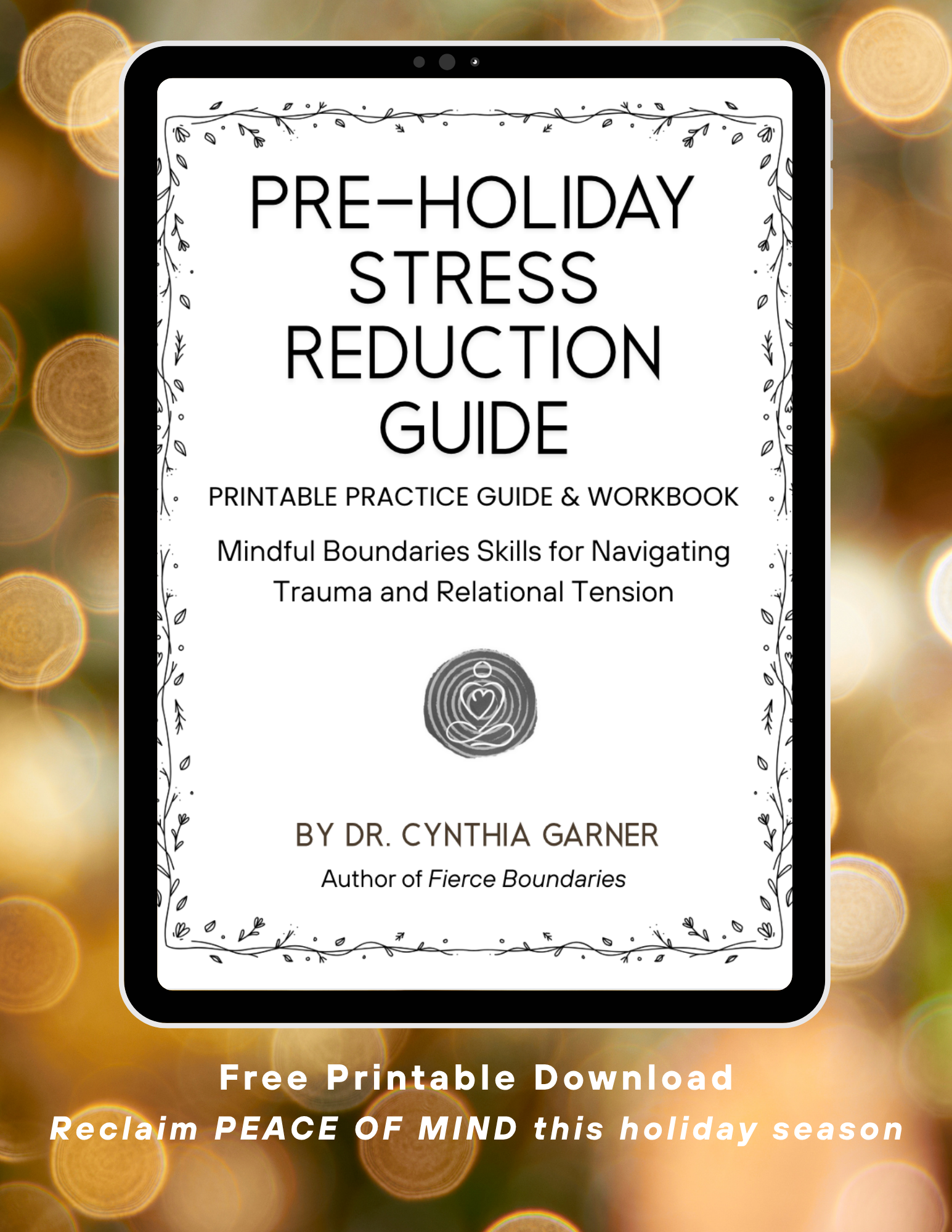
What's Inside Your Free Pre-Holiday Stress Reduction Guide?
Mindful Boundaries scripts and affirmations for navigating difficult conversations and family dynamics.
Printable boundary-setting worksheets to clarify your needs, limits, and availability.
Practical mindfulness and somatic exercises to regulate your nervous system, reduce stress, and stay grounded.
When the Holidays Trigger Stress & Anxiety:
Mindful Boundaries for Navigating Difficult Family Dynamics
By Dr. Cynthia Garner
The holidays are supposed to be a time of joy, celebration, and connection. Yet for many of us, this season brings a familiar sense of dread. Even before the decorations go up, we may begin to feel the pressure of expectations, the exhaustion of too many commitments, or the anxiety of gathering with family members who have caused us harm.
For those of us with a history of relational trauma or family dysfunction, holiday stress can be particularly complex. The nervous system remembers experiences that our conscious minds may prefer to leave behind. Sometimes, even the simplest holiday traditions can provoke a surprising amount of distress.
I know this experience intimately.
I grew up in a household defined by chaos and explosiveness. When holidays arrived, everyone would cross their fingers and hope that perhaps this would be the one day we could get through without an argument or an explosion. We placed enormous pressure on celebrations to be perfect, or at least to be peaceful.
As an adult, I've noticed how these early experiences continue to shape my relationship with the holidays. Even something as seemingly joyful as decorating the Christmas tree or putting up holiday lights can bring on that familiar flutter of panic.
As a mother, this has been especially challenging. I want to create joyful experiences for my daughter. I want her to enjoy the festivities and traditions of the season. And I also have to recognize when my own nervous system is becoming overwhelmed.
Over time, I've learned that navigating holiday stress skillfully requires us to pay attention to what's happening inside ourselves, recognize when we're becoming activated, and develop the capacity to choose how we respond.
Why Holiday Stress Can Feel So Overwhelming
Holiday stress often involves more than a busy calendar or an overflowing shopping list.
We experience an uptick in activity that doesn't necessarily coincide with our natural rhythms and biology. There are financial pressures, gift-giving expectations, disruptions to routines, and social obligations. We may also encounter difficult family dynamics, unresolved conflicts, or conversations that touch on deeply held beliefs and painful experiences.
For people with histories of relational trauma, these circumstances can activate familiar patterns of anxiety, people-pleasing, avoidance, and hypervigilance.
Perhaps you recognize some of these experiences:
Feeling responsible for everyone else's happiness.
Dreading conversations with particular family members.
Rehearsing what you'll say before a gathering.
Feeling pressured to participate in traditions that no longer nourish you.
Becoming overwhelmed by the emotional intensity of family interactions.
Feeling lonely, even when surrounded by people.
Experiencing physical tension, fatigue, or anxiety as the holidays approach.
When we're caught in these patterns, our attention often becomes consumed by stories about what happened in the past or what might happen in the future.
We anticipate the argument. We remember the hurtful comment. We imagine how someone might react if we say no. And before anything has even happened, our bodies may already be responding as though we're in danger.Mindful Boundaries: A Different Way of Navigating the Holidays
One of the most important things I've learned through my own healing and my work as a mindfulness educator is that boundaries begin long before we communicate them to someone else.
They begin with our capacity to notice what's happening within us.
When we're caught in a stress response, our attention can become consumed by fear, anticipation, and habitual patterns of reactivity. We may find ourselves agreeing to things we don't want to do, engaging in conversations that leave us feeling depleted, or abandoning our own needs in an effort to keep the peace.
Mindfulness offers us an opportunity to interrupt these patterns.
By learning to recognize the early signs of nervous system activation, ground our attention in the present moment, and relate to our experiences with curiosity and compassion, we begin to create more space for choice.
And choice is essential to mindful boundaries.
We can learn to recognize what we're available for and what we're not available for. We can develop the capacity to remain grounded in difficult conversations. And we can practice holding ourselves with dignity, even when the people around us are behaving in ways that feel hurtful or destabilizing.
These are skills that can be learned and practiced, and they can make a meaningful difference in how we experience the holidays.
You Don't Have to Hold It All Together
There can be enormous pressure during the holidays to maintain traditions, preserve appearances, and create the perfect experience for everyone around us.
I remember a particularly difficult year when I knew that my marriage was coming to an end. I desperately wanted to make it through the holidays before having that conversation. I wanted to hold everything together just a little longer, for our daughter, because we had already bought a turkey for Thanksgiving.
But my body wouldn’t let me postpone it any longer, and then my therapist read me the Journey by Mary Oliver and reminded me that “there is never a good day to ask for a divorce.”
The physical and emotional weight of trying to maintain appearances had become unmanageable. I was experiencing significant pain and illness, and I finally reached a point where I couldn't continue.
I asked for a divorce the day before Thanksgiving, even though I had planned to wait until “after the holidays”.
Paired with the grief was the tremendous relief of finally speaking the truth about what I was experiencing. The holidays were going to be difficult that year regardless, and I couldn’t pretend or stay quiet any longer.
That experience taught me something important about the expectations we place on ourselves during this season.
Sometimes the most compassionate thing we can do is acknowledge what is actually happening in our lives and give ourselves tools that help us to respond skillfully, rather than react automatically. We don't have to sacrifice our wellbeing to preserve someone else's idea of what the holidays should be.
Finding Our Way Back to Ourselves
One of the central teachings in my work is that your nervous system is the intervention.
When we learn to recognize our own patterns of activation and develop practical skills for regulating our nervous systems, we become better equipped to navigate challenging relationships and circumstances. This doesn't mean we can control how other people behave, but we can cultivate agency and the capacity to choose how we relate to what is happening.
We can learn to pause before reacting, recognize when a boundary is needed, and reconnect with the internal resources that help us feel grounded and supported. Perhaps we can even begin to imagine a holiday season that feels spacious, nourishing, and authentic, one in which we're able to experience deeper connection without bleeding ourselves dry.
Your Free Holiday Stress Reduction Guide
If you're anticipating difficult family dynamics, holiday anxiety, or the familiar pressure to do too much for everyone else this season, I've created a practical resource to support you.
The Holiday Stress Reduction Guide for Navigating Trauma and Relational Tension brings together mindfulness practices, somatic exercises, and practical boundary-setting strategies to help you navigate the holidays with greater clarity, compassion, and agency.
Inside, you'll find tools to help you recognize when your nervous system is becoming activated, prepare for difficult family interactions, and make more intentional choices about how you spend your time and energy.
Dr. Cynthia Garner, D.B.H., CMT-P, MFA, is the author of Fierce Boundaries: Practical Skills and Somatic Exercises for Healing in a Traumatized World. Her work integrates trauma-sensitive mindfulness, somatic awareness, and contemplative practice to help people cultivate greater agency, presence, and connection in their everyday lives.